
The Most Talked-About Cryptids
Creatures That Refuse to Disappear

Across cultures and continents, stories of strange creatures lurking just beyond the edge of civilization have persisted for centuries. These beings—known as cryptids—occupy a gray area between folklore, eyewitness testimony, and modern conspiracy culture. While mainstream science remains skeptical, cryptids continue to capture public attention, inspire investigations, and dominate online discussions. Whether seen as misunderstood animals, hoaxes, or something more mysterious, these creatures refuse to fade away.
Here are some of the most talked-about cryptids and why they continue to haunt the modern imagination.
Bigfoot (Sasquatch)
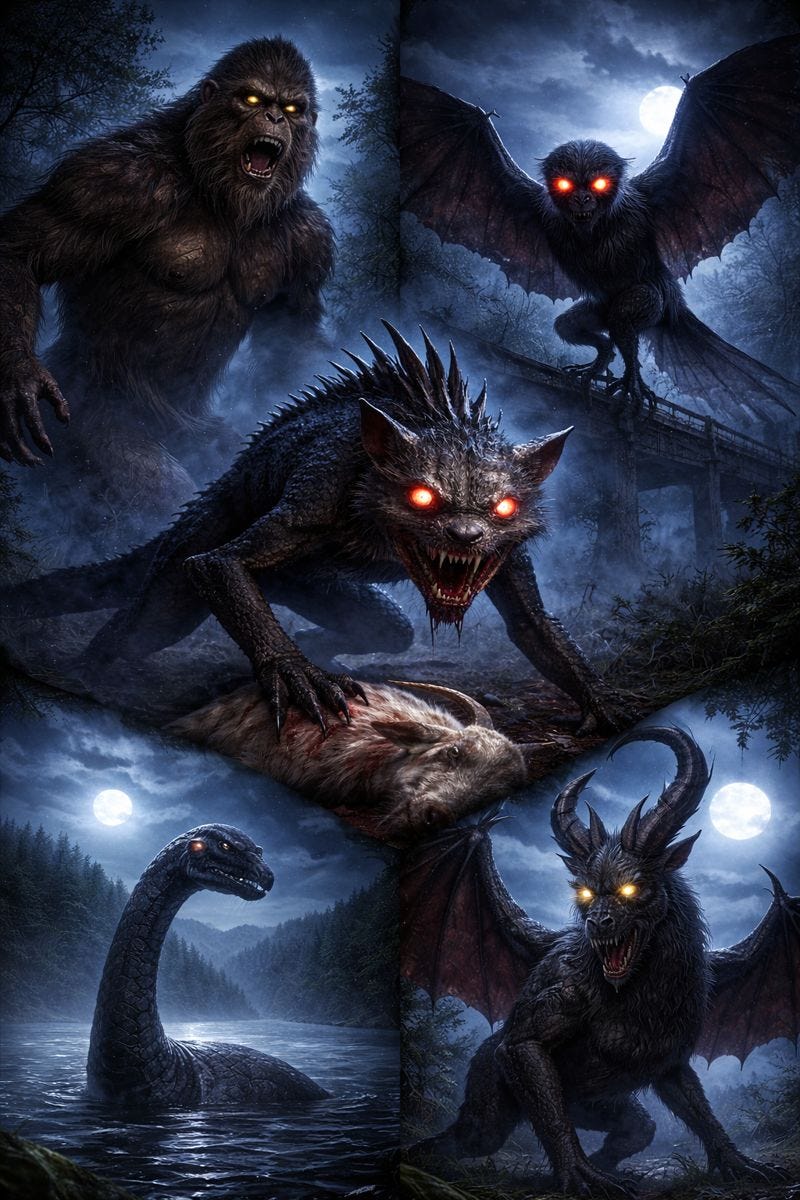
No cryptid is more famous—or more divisive—than Bigfoot. Reported sightings span decades across North America, particularly in the Pacific Northwest. Witnesses describe a massive, bipedal, ape-like creature covered in hair, often seen deep in forests or crossing remote roads.
Skeptics argue that Bigfoot sightings are cases of misidentified bears, hoaxes, or folklore amplified by media. Supporters counter with footprint casts, audio recordings, and thousands of eyewitness accounts. Despite decades of searching, no definitive physical evidence has emerged. Yet Bigfoot remains the gold standard of cryptid culture, spawning documentaries, research groups, and a thriving subculture convinced that something large and intelligent is hiding in the wilderness.
The Loch Ness Monster (Nessie)
Scotland’s Loch Ness Monster is one of the earliest cryptids to gain international fame. Sightings date back over a thousand years, but modern interest surged in the 20th century with photographs and sonar scans suggesting a large, unknown creature living in the depths of Loch Ness.
Descriptions of Nessie vary, but many portray a long-necked, plesiosaur-like animal. Scientific expeditions have largely debunked famous photos and found no evidence of a large breeding population. Still, sonar anomalies and eyewitness reports keep the legend alive. Nessie endures as a symbol of mystery and tourism, blending ancient myth with modern technology.
The Chupacabra
First reported in Puerto Rico in the mid-1990s, the chupacabra quickly became one of the most talked-about cryptids in the Americas. Its name—meaning “goat-sucker”—comes from reports of livestock found dead with puncture wounds and alleged blood loss.
Early descriptions depicted a spiny, reptilian creature with glowing eyes, while later sightings described hairless, canine-like animals in Mexico and the United States. Many scientists attribute these sightings to animals suffering from mange, but believers argue that some cases don’t match known predators. The chupacabra reflects modern anxieties about genetic experiments, government secrecy, and invasive species, making it a uniquely contemporary cryptid.
Mothman
The Mothman is less an animal and more a harbinger. Sightings in Point Pleasant, West Virginia, during the 1960s described a tall, winged humanoid with glowing red eyes. These sightings preceded the tragic collapse of the Silver Bridge in 1967, leading some to believe Mothman was a supernatural warning rather than a flesh-and-blood creature.
Unlike other cryptids, Mothman is often associated with disasters, UFO sightings, and paranormal activity. Skeptics suggest misidentified birds or mass hysteria, but Mothman’s connection to prophecy and catastrophe keeps it firmly rooted in cryptid lore—and popular culture.
The Jersey Devil
Deep in the Pine Barrens of New Jersey, legends of the Jersey Devil date back to the 18th century. Descriptions vary wildly: a kangaroo-like body, bat wings, hooves, horns, and a terrifying scream. The creature is said to terrorize livestock and wander the forests unseen.
Historically, the Jersey Devil may have originated as a political smear or cautionary tale, but sightings have continued into the modern era. Its longevity makes it one of America’s oldest cryptids and an enduring example of how folklore can evolve into something seemingly real.
Dogman
Closely related to werewolf legends, Dogman sightings describe a tall, muscular, canine-headed creature that walks upright. Reports come primarily from the United States and Canada, with many witnesses claiming close encounters rather than fleeting glimpses.
Unlike Bigfoot, Dogman is often described as aggressive or threatening, adding a layer of fear to its mythology. Skeptics dismiss Dogman as urban legend or psychological suggestion, while believers argue that consistency across independent reports suggests something unexplained.
Yeti (Abominable Snowman)
The Himalayan counterpart to Bigfoot, the Yeti has been reported for centuries in Nepal, Tibet, and surrounding regions. Described as a large, hairy humanoid adapted to cold, mountainous environments, the Yeti has been referenced in local folklore long before Western explorers took interest.
DNA analysis of alleged Yeti samples has linked them to known animals like bears, but sightings persist. The Yeti remains a powerful symbol of humanity’s fear—and fascination—with uncharted wilderness.
Why Cryptids Persist
Cryptids endure because they occupy a unique psychological and cultural space. They thrive where uncertainty exists: dense forests, deep lakes, remote mountains, and the dark corners of human perception. In an era of satellites and smartphones, cryptids challenge the belief that everything has been discovered and explained.
They also reflect deeper themes—distrust of authority, fear of the unknown, and the human desire for mystery. Even when evidence falls short, the stories themselves continue to evolve, reinforced by social media, podcasts, and online communities.
Myth, Misidentification, or Something Else?
Most scientists agree that cryptids are unlikely to represent undiscovered large species. However, that doesn’t mean the phenomenon itself is meaningless. Cryptids reveal how humans interpret uncertainty, process fear, and pass stories through generations. Whether rooted in misidentified animals, hoaxes, or psychological patterns, cryptids tell us as much about ourselves as they do about the creatures we imagine.
In the end, cryptids remain compelling not because they are proven—but because they are possible enough to keep us wondering. And as long as unexplained sightings continue, these creatures will remain part of our collective imagination, lurking just beyond the edge of certainty.
.